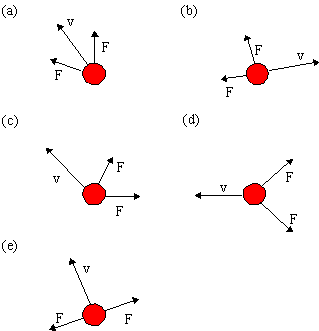
- In the diagrams below, a ball is on a flat horizontal
surface. The initial
velocity and constant external forces acting on the ball are indicated.
Describe qualitatively how motion the motion of the ball will change.
- Three forces F1
= (25.0N, 42.5°),
F2
= (15.5N, 215°), and F3
= (20.5N, 155°) accelerate
an 8.75 kg mass. What is the net force acting on the mass? What is the
magnitude and direction of the mass's acceleration?
- What would have to be the magnitude and direction of a
fourth force F4
in question 2 so that the acceleration of the mass would be zero?
- A rifle bullet with a mass of 100 g leaves the rifle with a
muzzle velocity
of 500 m/s. If the barrel is 0.75 m long, calculate the average
acceleration
of the bullet. Calculate the average force that the exploding gunpowder
exerts on the bullet. If the rifle has a mass of 7.50 kg, what is its
average
acceleration?
- You are thrown from a bicycle and skid in a straight line
to a complete
stop on a rough gravel path. A measurement of the bloody skidmark
reveals
that it is 3.50 m long. What average force did the gravel exert on your
anatomy? Assume that your mass is 70.0 kg and that your initial speed
was
30 km/h.
- The 80.0-kg male partner of a figure skating duo pushes his
60.0-kg female
partner with a force of 70.0N. Find the acceleration of both partners.
- An 800-kg artillery piece horizontally fires a 10.5-kg
shell with a muzzle
velocity of 450 m/s. The barrel is 3.75 m long. What is the
acceleration
of both?
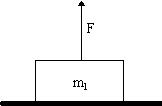
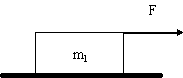
- If m1 = 25.0 kg, calculate the
normal force on the bottom mass
if the applied force, F, is (a) 100 N, (b) 245 N,
and (c) 500 N.
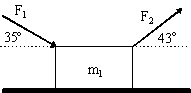
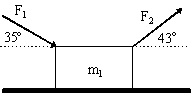
- What is the normal force on the object of mass m1
shown in the
diagram? What is the acceleration of the object? In the diagram F1
= 25 N,
F2 = 15 N, and m1
= 20 kg.
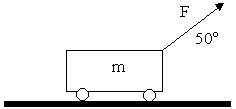
- A physics instructor is pulling a string with a constant
force of 1.00 Newtons. The string is attached to a toy on a
frictionless surface. The string makes a 50° angle with the
horizontal. The toy has a mass of 0.400 kg. Find the acceleration of
the toy.
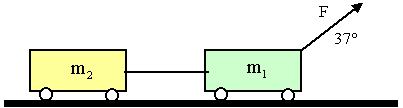
- Two blocks are connected by a string. The blocks have
masses of 1.50 kg and 1.20 kg. The heavier block is being pulled by a
force of 8.00 N at angle of 37°
to the floor. Assume the floor is frictionless. Find the tension in the
string between the blocks.
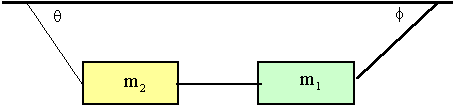
- Two blocks are connected by strings to the ceiling as shown
in the diagram below. The left block has mass m2
= 3.35 kg. The mass of the right block m1 is
unknown. The strings make angles θ
= 60° and φ =
45° with the ceiling. Find the tension in the level string
connecting the blocks. Find m1.
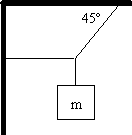
- In the diagram below, the mass of the object is 50.0 kg.
What are the tensions
in the ropes?
- The apparent weight of a person in an elevator is 7/8th
of his
actual weight. What is the acceleration (including the direction) of
the
elevator?
- A 1200-kg elevator is carrying an 80.0-kg passenger.
Calculate the acceleration
of the elevator (and hence of the partner) if the tension in the cable
pulling the elevator is (a) 15,000 N, (b) 12,557 N, and (c) 10,000 N.
What
is the apparent weight of the passenger in each case. Assume g = 9.81
m/s2.
- A person is standing on a weigh scale in an elevator. When
the elevator
is accelerating upwards with constant acceleration a the scale reads
867.0
N. When the elevator is accelerating downwards with acceleration a, the
scale reads 604.5 N. Determine the acceleration a, the true weight of
the
person, and the mass of the person.
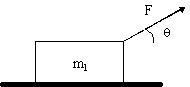
- In the diagram below, m = 10.0 kg, θ
= 25.0°,
μs
= 0.70, and μk
= 0.50. What is the
frictional force if F is (a) 25 N, (b) 65 N, and
(c) 100 N? What
is the acceleration in each case?
- (a) If m = 10.0 kg, μk
= 0.3, and
F
= 50 N i, find a.
(b) If m = 10.0 kg, a = 2.5 m/s2
i and
F
= 75 N i, find μk.
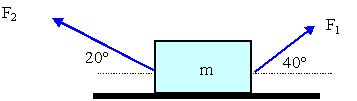
- A 15.0-kg block sitting on a floor is pulled by two forces
as shown in the diagram below. The block does not move. Find the type,
magnitude, and direction of the frictional force acting on the block.
Note F1 = 48.0 N and F2 =
40.0 N.
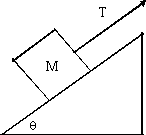
- A block weighing 100 N is placed on a plane with slope
angle 30.0°
and is pulled by a rope which is parallel to the incline and under
tension
T as shown below. The coefficient of static friction is 0.52, and the
coefficient
of kinetic friction is 0.20.
(a) Find the tension T for which the block moves up the plane at
constant
speed, once it has been set in motion.
(b) Find the tension T for which the block moves down the plane at
constant speed, once it has been set in motion.
(c) What is the maximum value of T for which the block will remain at
rest?
(d) What is the minimum value of T for which the block will remain at
rest?
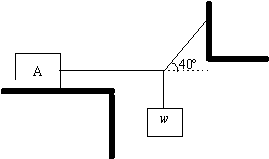
- In the diagram below, block A weighs 100 N. The coefficient
of static friction
between the block and the surface on which it rests is 0.40. Find the
maximum
weight w for which the system will remain in
equilibrium.
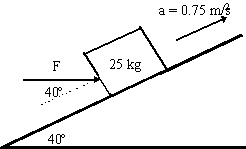
- When a force of 500 N pushes on a 25-kg box as shown in the
figure below,
the acceleration of the box up the incline is 0.75 m/s2.
Find
the coefficient of sliding friction between box and incline.
- A 20-kg box sits on an incline as shown below. The
coefficient of kinetic
friction between the block and incline is 0.30. Find the acceleration
of
the box down the incline.
-
A 5.0-kg block is on the a 20° incline. The coefficients of friction
between the block and incline are μs = 0.52 and μk
= 0.38.
(a) Does the block stay in place if the block is gently placed on the incline?
(b) If you gave the block a gentle nudge, would it slide down the incline?
(c) What must be the minimum angle θ of the incline if the block will
always slide down the incline and never stay in place?
A 10.0-kg block is on a tabletop. The coefficients of friction
between the block and tabletop are μs = 0.28 and μk
= 0.18. A string is strung over a massless pulley to a hanging mass of 2.0 kg. But
the hanging block is being held to keep everything motionless.
(a) Does the block on the tabletop move, if the hanging block is released?
(b) How much friction is acting on the block on the tabletop?
(c) What mass of hanging block is needed to just get the blocks to move?
(d) Ifthere is a slight nudge given in (c), what is the acceleration of the blocks?
-
A
10-kg block is hanging from a spring with spring constant K = 1000 N/m.
The
spring is attached to the ceiling of an elevator. The elevator is
currently
moving upwards at 10 m/s and slowing down at 1.0 m/s2.
How much is
the spring stretched?
-
A 10-kg block is sitting on a vertical spring with spring constant K = 1000 N/m.
The spring is attached to the floor of an elevator. The elevator is
currently moving upwards at 10 m/s and slowing down at 1.0 m/s2.
How much is the spring stretched or compressed? Indicate which.
![[Return to Physics Homepage]](../../physics.gif)
![[Return to Mike Coombes' Homepage]](../../coombes.gif)
![[Return to List of Handouts]](../../handouts.gif)
![[Return to Problem Sets]](../../problems.gif)
![[Return to List of Solutions]](../../solutions.gif)
![[Return to Kwantlen Homepage]](http://www.kpu.ca/images/return_button.gif)