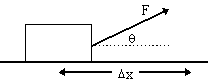
- In the diagram below, calculate the work done if
(a) F = 15.0 N, θ = 15°, and Δx
= 2.50 m,
(b) F = 25.0 N, θ = 75°, and Δx
= 12.0 m,
(c) F = 10.0 N, θ = 135°, and Δx
= 5.50 m,
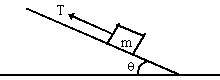
- In the diagram below, a rope with tension T = 150 N pulls a
15.0-kg block
3.0 m up an incline (θ = 25.0°). The coefficient
of kinetic friction is μk
= 0.20.
Find the work done by each force acting on the block.
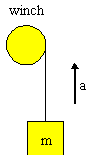
- A winch lifts a 150 kg crate 3.0 m upwards with an
acceleration of 0.50
m/s2. How much work is done by the winch? How
much work is done
by gravity?
- What work does a baseball bat do on a baseball of mass
0.325 kg which has
an initial speed forward of 36 m/s and a final speed of 27 m/s
backwards.
Assume motion is linear and horizontal. The work done by the bat is a
non-conservative
force.
Work and Energy: Wexternal
= ΔEsystem
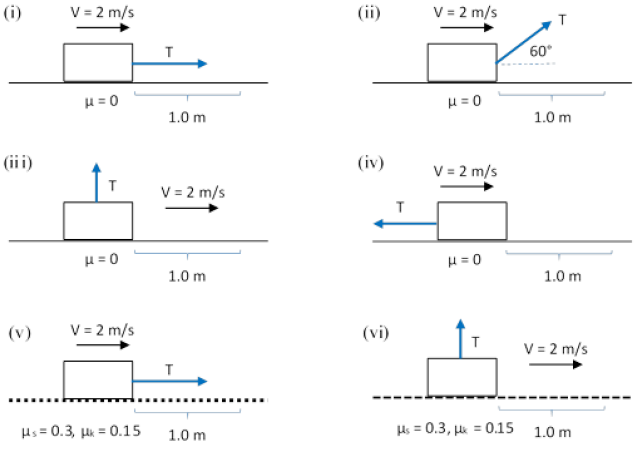
- Consider a 0.50-kg block travelling at 2.0 m/s on a
horizontal surface. At the instant shown, there is a rope with a tension
of 1.0 N attached while the block travels 1.0 m to the right. In each
case:
a. Determine what object(s) make(s) up the system.
b. Determine if the system is isolated or if there are external forces
are acting on the system.
c. Determine if there are internal forces to the system.
d. Find the final speed of the block.
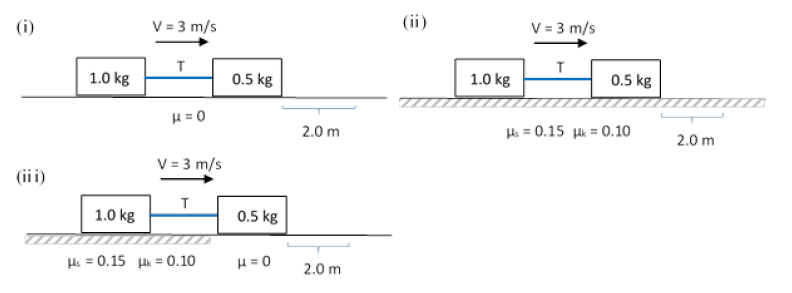
- Consider the blocks travelling at 5.0 m/s on a
horizontal surface in the diagrams below. The blocks travels 2.0 m to
the right. In each case:
a. Determine what object(s) make(s) up the system.
b. Determine if the system is isolated or if there are external forces
are acting on the system.
c. Determine if there are internal forces to the system.
d. Find the final speed of the block(s)
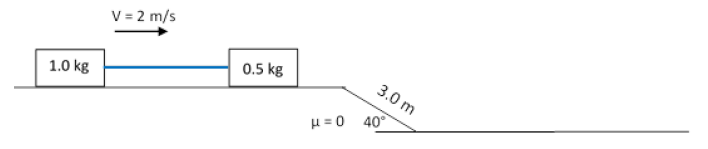
- Consider the two blocks travelling at 5.0 m/s on a
horizontal surface in the diagrams below. The blocks will one by one
slide down the 3.0 m-long, 40° incline to the lower side. The string
between the blocks is long enough so that the first block will be down
on the lower level before the second block hits the incline. In each
case:
a. Determine what object(s) make(s) up the system.
b. Determine if the system is isolated or if there are external forces
are acting on the system.
c. Determine if there are internal forces to the system.
d. Find the final speed of the blocks when just the first block reaches
the lower level.
e. Find the final speed of the blocks when both blocks reach the lower
level.
- How much work must be done to stop a 2000-kg car travelling
at 60 km/h
in 15.0 m? What was the average breaking force?
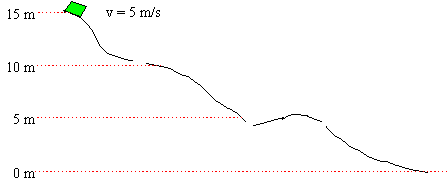
- In the diagram below, determine the speed of the block at
each point. Assume
no friction. The mass of the block is 10.0 kg.
- A 2.0-kg rock is thrown with initial speed of 9.8 m/s at an
unknown angle.
The speed of the rock at the top of the parabola is 2.1 m/s. How high
does
it go? Assume no air resistance.
-
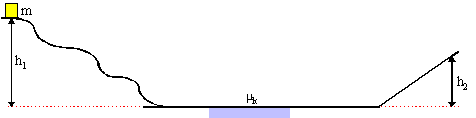
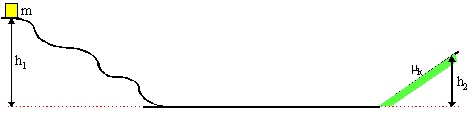
In the diagram below, a 5.00-kg block slides from rest at
a
height of h1
= 1.75 m down to a horizontal surface where it passes over a 2.00-m
rough
patch. The rough patch has a coefficient of kinetic friction μk
= 0.25. What height, h2, does the block reach on
the incline?
- In the diagram below, a 5.00-kg block slides from rest at a
height of h1
= 1.75 m down to a smooth horizontal surface until it encounters a
rough
incline. The incline has a coefficient of kinetic friction μk
= 0.25. What height, h2, does the block reach on
the
θ
= 30.0° incline?
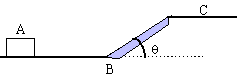
- In the figure below, a block of mass 5.0 kg starts at point
A with a speed
of 15.0 m/s on a flat frictionless surface. At point B, it encounters
an
incline with coefficient of kinetic friction μk
= 0.15. The block makes it up the incline to a second flat frictionless
surface. What is the work done by friction? What is the velocity of the
block at point C? The incline is 2.2 m long at an angle
θ
= 15°.
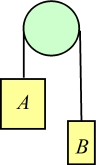
- Two
blocks are connected by a string hung over a
frictionless massless pulley. Block A
has mass MA
and block B has mass MB.
Initially the blocks are held at rest before being
allowed to move. How fast will block B
be moving when it has risen a distance h?
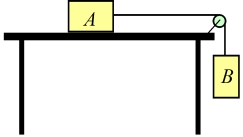
-
Two blocks are connected by a string hung over a
frictionless massless pulley. Block A
has mass MA
and is on a
table top. Block B has mass MB and is hanging
in the air.
Initially the blocks are held at rest. The coefficients of friction
between
block A and the tabletop are
μS
and μK.
(a) B is
allowed to fall. How fast will
block B be moving when it has
fallen
distance h?
(b) Block
A is
pulled to the left by a horizontal force F
for a distance L. How fast will
block
B be moving?
-
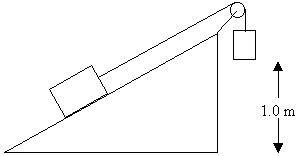
Two blocks are connected by a sting slung over a pulley as
shown in the
diagram below. The hanging block is allowed to drop. How fast
will it be moving when it hits the ground? The block on the incline
has mass MA = 2.50 kg. The hanging
block has mass MB
= 1.50 kg. The incline makes and angle θ
= 30° with horizontal. Ignore friction.
-
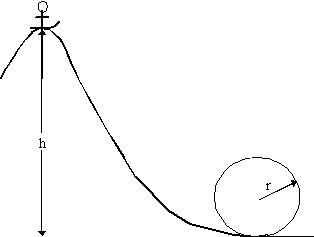
In the diagram, below what is the minimum height that the
skier must start
from to successfully make it around the loop. Assume (a) no friction,
and
(b) that friction does -3.0 × 10³ J of
work on the skier.
The radius is 5.00 m and the skier has mass 65.0 kg.
-
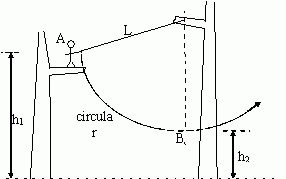
Tarzan, Lord of Apes, is swinging through the jungle. In
the diagram below,
Tarzan is standing at point A on a tree branch h1
= 22.0 m above
the floor of the jungle. Tarzan is holding one end of a vine which is
attached
to a branch on a second tree. The vine is L = 21.0 m long. When Tarzan
swings on the vine, his path is in an arc of a circle. At the bottom of
his swing he is at point B, 13.0 m above the ground . Ignore Tarzan's
height.
Tarzan has a mass of 90.0 kg. The vine does not stretch and has
negligible
mass.
(a) Why does the tension in the vine do no work?
(b) What will be his speed at point B?
(c) What will be the tension in the rope at point B?
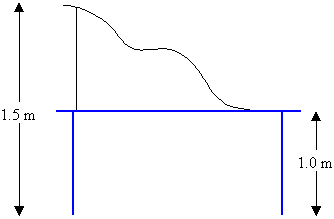
- A 0.200-kg block slides down the track and horizontally off
a table as
show in the diagram below.
(a) Assumingthat friction is negligible, how far
from the
table does the block land?
(b) The block only land 1.20 m away. How
much work
was done by friction and other non-conservative forces?
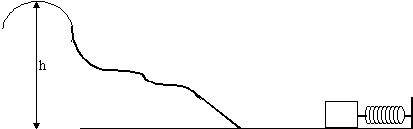
In the diagram below, the spring has a force constant of
5000 N/m, the block has a mass of 6.20 kg, and the height h of the hill
is 5.25 m. Determine the compression of the spring such that the block
just makes it to the top of the hill. Assume that there are no
frictional forces involved.
-
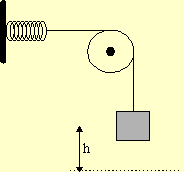
A block of mass m is connected by a string of negligible mass to
a spring with spring constant K which is in turn fixed to a wall. The
spring is horizontal and the string is hung over a pulley such that the
mass hangs vertically. The pulley is massless.As shown in the diagram below, the spring is initially in its
equilibrium position and the system is not moving.
(a) Use energy methods, to determine the speed v of the block after it
has fallen a distance h. Express your answer in terms of g, m, K, and h.
(b) The block will oscillate between its initial height and its lowest
point. At its lowest point, it turns around. Use your answer to part
(a) to find where it turns around.
-
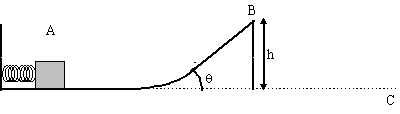
At point A in the figure shown below, a spring (spring
constant k = 1000 N/m) is compressed 50.0 cm by a 2.00 kg block. When released the
block travels over the frictionless track until it is launched into the
air at point B. It lands at point C. The inclined part of the track
makes an angle of θ = 55.0°
with the horizontal and point B is a height h = 4.50 m above the
ground. How far horizontally is point C from point B?
-
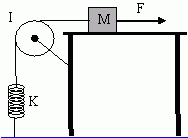
A block of mass M on a flat table is connected
by a string of negligible mass to a vertical spring with spring
constant K which is fixed to the floor. The string goes over a pulley that is a
solid disk of mass M and radius R. As
shown in the diagram below, the spring is initially in its equilibrium position and
the system is not moving. A person pulls the block with force F through a
distance L. Determine the speed v of the block
after it has moved distance L. The tabletop is frictionless.
- A 50-hp engine is used to lift heavy loads at a worksite.
It is used to
lift a load of bricks weighing 2000 N to the top of a new building 35.0
m above ground. How long does it take for the load to get to the top?
- A 5.0 MW generating station is situated at a 22-m high dam.
The energy
used to generate the electricity comes from the loss in potential
energy
of the water as it falls the height of the dam. What is the minimum
amount
of water going through the dam every day?
- What power is required to pull a 5.0-kg block at a steady
speed of 1.25
m/s? The coefficient of friction is 0.30.
- A 7000 W engine is propelling a speedboat at 30 km/h. What
force is the
engine exerting on the speedboat? What force and how much power is
water
resistance exerting on the speedboat?
![[Return to Physics Homepage]](../../physics.gif)
![[Return to Mike Coombes' Homepage]](../../coombes.gif)
![[Return to List of Handouts]](../../handouts.gif)
![[Return to Problem Sets]](../../problems.gif)
![[Return to List of Solutions]](../../solutions.gif)
![[Return to Kwantlen Homepage]](http://www.kpu.ca/images/return_button.gif)