Physics 1100 In-Class Problems: Electrostatics
Coulomb's Law
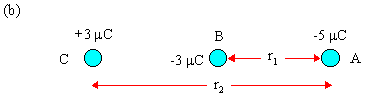
- What is the net force on charge A in each configuration shown
below? The distances are r1 = 12.0 cm and r2 =
20.0 cm.

-
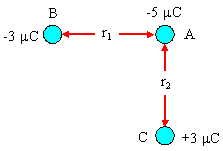
The distances in the diagram below are are r1 = 12.0
cm and r2
= 20.0 cm.
(a) Find the net Coulomb force on charge A in component form.
(b) Find the net Coulomb force on charge B in component form.
(c) Find the net Coulomb force on charge C in component form.
- Where would you put a positive charge of +1 μC
in the diagrams below so that the net electrostatic force on it is zero?

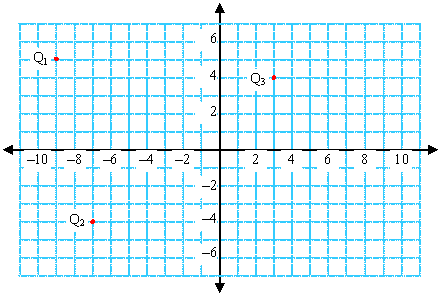
- The distances on the graph below are in metres. The charges are Q1
= –3 μC,
Q2 = 2 μC,
and Q3 = 5 μC.
(a) Find the net force on charge Q1 due to charges Q2
and Q3.
(b) Find the net force on charge Q2 due to charges Q1
and Q3.
(c) Find the net force on charge Q3 due to charges Q1
and Q2.
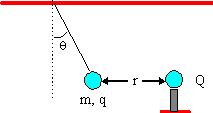
- A charged ball of mass m = 0.265 kg and unknown charge q is
hanging by
a light thread from a ceiling. A fixed charge Q = +5.00 μC
on an insulated stand is brought close to the unknown charge. As a
result,
the unknown charge now hangs motionless at an angle θ
=
38.0°
to the vertical as shown in the diagram below. The distance between the
two charges is r = 22.0 cm.
(a) What is the sign of the unknown charge? Explain how you know this.
(b) What is the tension in the string?
(c) What is the magnitude of the unknown charge?
Electric Field
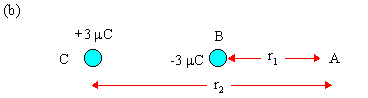
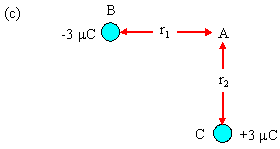
- What is the net electric field at point A in each configuration
shown below? The distances are r1 = 12.0 cm and r2
= 20.0 cm.
In each case, determine the magnitude and direction of the
electrostatic force on a charge put at point A if the charge is (i) -5 μC,
(ii) 2 μC, or (iii) -7 μC.

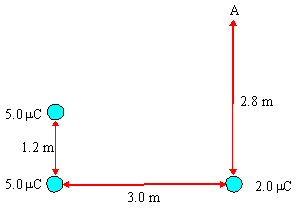
- Find the net electric field at point A in the diagram below.
- A small ball of mass m = 0.015 kg is suspended floating with
nothing touching it in an
electric
field of magnitude E = 5000 N/C. (a) If the electric field is pointing
straight up into the air, what is the charge on the ball? (b) If E
points
straight down?
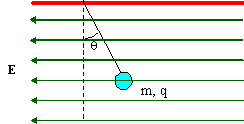
- A ball of mass m = 0.010 kg and charge q is tied by a very light
string
to the ceiling. The effects of a uniform electric field E =
5000
N/C has caused the charged ball to move to one side so that the string
makes an angle of θ = 37° with the
vertical.
It hangs there motionless. Draw the free body diagram of the floating
ball. Determine the
magnitude
of the charge q. How can you tell the sign (positive or negative) of
the
charge?
Electric Potential
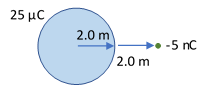
- A small charge of mass q = -5.0 nC and mass m = 0.100 g is released from rest at 2.00 m
from a sphere of radius R = 2.00 cm carrying a charge of 25 μC. How fast
will the small charge be travelling when it is 1.00 m from the sphere? Ignore
gravity.
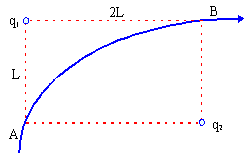
- Two fixed point charges of q1 = 3.0 μC and q2 = 4.0
μC are situated at the opposite corners of a rectangle as shown below.
The short side has length L = 0.25 m. Find the total potential at points A and
B. If a free particle of charge qf = 1.0 μC and mass M = 15 g has
speed vA = 2.50 m/s at point A and it follows the indicated path,
what will be its speed at point B?
- Two fixed point charges, q1 = 3.0 μC and unknown charge q2,
are situated at the opposite corners of a rectangle as shown below.
The short side has length L = 0.25 m. If a free particle of charge qf
= 1.0 μC and mass M = 15 g has constant speed vA = 2.50 m/s as it follows
the indicated path from A to B, what is q2?
- A metal sphere of radius 15.0 cm carries charge Q1 = 12 μC. A
second sphere of radius 5.00 cm carries a charge Q1 = −8 μC. What
will be the final charge on each sphere when they are connected by a metal wire?
- There are three identical metal spheres, A, B, and C. Sphere A carries
a charge of +5q. Sphere B carries a charge of -q. Sphere C carries no charge.
Spheres A and B are touched together then separated. Sphere C is then touched
to sphere A and separated from it. Lastly, sphere C is touched to sphere
B and separated from it. How much charge ends up on sphere C?
Questions?mike.coombes@kpu.ca
![[Return to Kwantlen Homepage]](http://www.kpu.ca/images/return_button.gif)
![[Return to Physics Homepage]](../../physics.gif)
![[Return to Mike Coombes' Homepage]](../../coombes.gif)
![[Return to List of Handouts]](../../handouts.gif)
![[Return to Problem Sets]](../../problems.gif)
![[Return to List of Solutions]](../../solutions.gif)