![[Return to Physics Homepage]](../../physics.gif)
![[Return to Mike Coombes' Homepage]](../../coombes.gif)
![[Return to List of Handouts]](../../handouts.gif)
![[Return to Problem Sets]](../../problems.gif)
![[Return to List of Solutions]](../../solutions.gif)
|
|
|
|
|
Neatly sketch the following dot-motion diagrams:
(a)A particle moving right at constant speed.
(b)A particle moving right and speeding up.
(c)A particle moving right and slowing down.
(d)A particle moving left at constant speed.
(e)A particle moving left and speeding up.
(f)A particle moving left and slowing down.
Use the definition of acceleration  to draw
the direction of the acceleration at a midpoint of the sketch from
Question 1.
to draw
the direction of the acceleration at a midpoint of the sketch from
Question 1.
Describe in simple terms the motion of the particles in the dot-motion diagrams below.
(a)

(a) Sketch x-t graphs for Question 1.
(b) Sketch x-t graphs for Question 4(a) and 4(b).
(a) Sketch v-t graphs for Question 1.
(b) Sketch v-t graphs for Question 4(a) and 4(b).
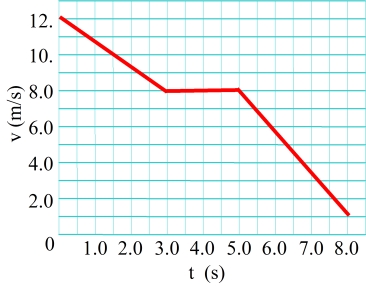
Draw a dot-motion diagram and an x-t graph from the
following v-t graph.
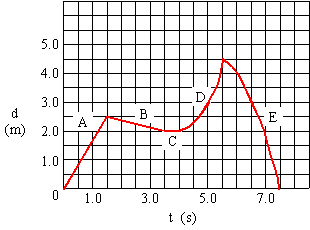
From the position versus time graph given below, determine the average velocity in segments A to E. Is the average acceleration in each segment zero, negative, or positive? What is the average velocity over the entire time interval?
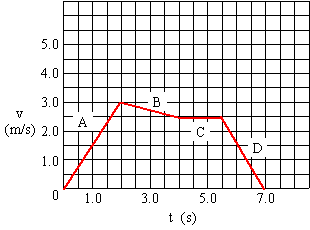
From the velocity versus time graph below, determine the acceleration in all segments. What is the average velocity in each segment? What is the displacement in each segment? What is the average velocity over the entire time interval?
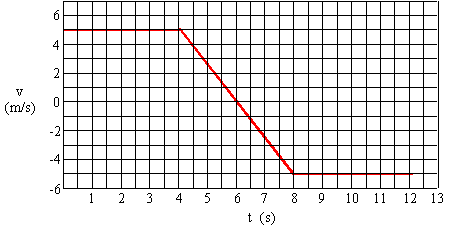
The velocity versus time sketch shown below is for a ball
rolling across
a horizontal floor, rolling up then down an incline, and finally
rolling
back across the floor.
(a) At what time does the ball encounter the incline?
(b) When is it at the top of the incline? How do you know this?
(c) When does it leave the incline?
(d) What was the acceleration of the ball up the incline?
(e) What was the acceleration of the ball down the incline?
A skytrain starts from rest at a station and accelerates at a rate of 1.60 m/s2 for 8.00 s. It then runs at a constant velocity for 12.0 s, and slows down at 2.50 m/s2 until it stops at the next station. Sketch the d versus t graph. Find the time for the last segment. Find the average velocity in each segment. Find the total distance between these two stations. Assume the track is straight between the two stations.

The record for the 100 m dash is 9.90 s. Calculate the average speed over this distance.
The moon moves around the earth in a circle of radius 3.84 × 10⁸ m. The time for one complete trip of the moon around the earth is 27.3 days. Calculate the moon's average speed in m/s and km/h. Recall that the circumference of a circle is C = 2πr; a fact you should remember for this course.
A jogger runs four times around an oval track of circumference 400 m and finishes where she started. If it takes her 10 minutes to complete her run, what was her average speed? Her average velocity? Why are they different?
A certain brand of car can accelerate from 0 to 60 km/h in 4.20 s. What is it's acceleration? What is it's average velocity? How far did it travel?
A bullet in a rifle accelerates uniformly from rest at a = 70000 m/s2 barrel. If the muzzle velocity of the bullet is 500 m/s, how long is the rifle barrel? How long did it take for the bullet to travel the length of the barrel? What is the average velocity of the bullet?
Initially, a ball has a speed of 5.0 m/s as it rolls up an
incline.
Some time later, at a distance of 5.5 m up the incline, the ball has a
speed
of 1.5 m/s DOWN the incline.
(a)What is the acceleration? What is the average velocity? How much
time did this take?
(b)At some point the velocity of the ball had to have been zero. Where
and when did this occur?
A tortoise and a hare have a 25.0 m race. The tortoise moves at a slow but constant 0.101 m/s while the hare accelerates from rest at 0.500 m/s2. The hare magnanimously gives the tortoise a 4.00-minute headstart. Who wins? Explain with calculations.
(Of course, in the modern telling of the story, the hare would be proclaimed the winner after a random drug test showed that the tortoise had been taking steroids!)
A ball is thrown up into the air. At one point it has an upward velocity of 10.0 m/s. Some time later, it has a downward velocity of 12.0 m/s. How much time passed between these two events? What is the displacement between the ball at those two heights? What total distance did the ball travel between those times?
A woman standing on the edge of a bridge fires a pistol once straight up into the air and one straight down. Which bullet will hit the river below with the greatest velocity? Ignore the effects of air resistance and assume the opening of the pistol barrel is at the same level in each case. If the gun is held 120 m above the river and has a muzzle velocity of 325 m/s, find the following in each case: the time in air and the average velocity. In the first case how far did the bullet rise? What total distance did it travel?
A person in a building is 12.0 m above a person walking below. She plans to drop a water balloon on him. He is currently walking directly towards a point under her at 2.75 m/s. How far away should he be when she drops the balloon if she is to hit him?
A red car is stopped at a red light. As the light turns green, it accelerates forward at 2.00 m/s2. At the exact same instant, a blue car passes by travelling at 62.0 km/h. When and how far down the road will the cars again meet? Sketch the d vs t motion for each car on the same graph. What was the average velocity of the red car for this time interval? For the blue car? Compare the two and explain the result?
A bicyclist travelling at 8.0 m/s passes a napping dog. Startled, the dog barks for three seconds and then gives chase accelerating at 2.2 m/s2. How far from her initial position does the dog catch up with the bicyclist? How long did this take? What is the dog's velocity when she catches the bicyclist? Her average velocity for the entire chase? Compare this to the bicyclist's average velocity.
A speeding motorist traveling down a straight highway at 110 km/h passes a parked patrol car. It takes the police constable 1.0 s to take a radar reading and to start up his car. The police vehicle accelerates from rest at 2.1 m/s2. When the constable catches up with the speeder, how far down the road are they and how much time has elapsed since the two cars passed one another?
|
|
|
|
|
Questions? mike.coombes@kpu.ca
![[Return to Kwantlen Homepage]](http://www.kpu.ca/images/return_button.gif)