Exercises
In the following experiments, the experimental data needs to be converted into a linear graph. In each case, answer the four questions:
1. What do we plot on the horizontal or x axis?
2. What do we plot on the vertical or y axis?
3. What should the slope of the straight line be?
4. What should the y-intercept of the straight line be?
Also, if necessary, do uncertainty propagation to find the uncertainty in the experimental quantity you are looking for.
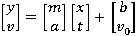
a. The velocity of a glider on an inclined frictionless airtrack is given by the formula
v = v0 + at.
The velocity v is measured at various times t. We are interested in measuring the acceleration.
|
Answer
So a = m and Da = Dm |
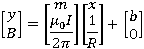
b. The magnetic field B at the centre of a circular loop of wire of radius R and carrying current I is given by the formula
B = m0I/2pR.
where m0 is the permeability of free space. While the current I is kept constant, the radius R of the circular loop is varied and the magnetic field B is measured. We are interested in measuring m0 and comparing it to its accepted value m0 = 1.2566 × 10⁻⁶ T-m/A.
|
Answer
So m0 = 2pm/I and Dm0/m0 = 2p (Dm/m + DI/I) |
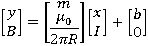
c. The magnetic field B at the centre of a circular loop of wire of radius R and carrying current I is given by the formula
B = m0I/2pR.
where m0 is the permeability of free space. While the radius R of the circular loop is kept constant, the current I in the loop is varied and the magnetic field B is measured. We are interested in measuring m0 and comparing it to its accepted value m0 = 1.2566 × 10⁻⁶ T-m/A.
|
Answer
So m0 = 2pmR and Dm0/m0 = 2p (Dm/m + DR/R) |
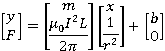
d. The force of attraction F between two straight wires separated by a distance r and each carrying an equal but opposite current I is given by the formula
F = m0I2L/2pr2.
where m0 is the permeability of free space. For fixed length L of wire and current strength I, the force F between the wires is measured as their separation r is changed. We are interested in measuring m0 and comparing it to its accepted value m0 = 1.2566 × 10⁻⁶ T-m/A.
|
Answer
So m0 = 2pm/I2L and Dm0/m0 = 2p (Dm/m + 2DI/I + DL/L) |
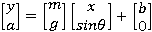
e. The acceleration, a, of a cart on an inclined plane is given by the formula
a = gsinq
where g is the acceleration due to gravity and q is the angle that the incline makes to the horizontal. As the angle q is changed, the acceleration a is measured. We are interested in measuring g and comparing it to its accepted value g = 9.81 m/s2.
|
Answer
So g = m and Dg = Dm |
f. The velocity v of a ball bearing on a banked curve is given by the formula
v2 = Rgtanq
where g is the acceleration, R is the radius of curvature of the banked curve, and q is the angle at which the curve banks, i.e. makes to the horizontal. The velocity v is measured as the banking angle q is changed. The radius of curvature R is kept constant. We are interested in measuring g and comparing it to its accepted value g = 9.81 m/s2.
|
Answer
So g = m/R and Dg/g = (Dm/m + DR/R) |

g. The velocity v of a ball bearing on a banked curve is given by the formula
v2 = Rgtanq
where g is the acceleration, R is the radius of curvature of the banked curve, and q is the angle at which the curve banks, i.e. makes to the horizontal. The velocity v is measured as the radius of curvature R is changed. The banking angle q is kept constant. We are interested in measuring g and comparing it to its accepted value g = 9.81 m/s2.
|
Answer
So g = m/tanq and Dg/g = (Dm/m + Dq/cos2q). Note Dq must be in radians! |
